

Trying to determine whether you need a solar system backup generator can be frustrating. If you’re not sure you need one, you’ve come to the right place. The first question to answer is what type of solar system your home uses. Then, do you plan to achieve total energy independence?
Regarding the second question, a solar system backup generator certainly provides total energy independence. But, there’s a cost both upfront and during use. Running a solar system backup generator costs money in gasoline and it defeats the purpose of helping the environment.
Although a solar system backup generator has a downside, it is your last defense when two conditions occur. The first condition is lack of sunshine for extended periods of time. Then, the next condition occurs when your battery bank runs low while your solar panels are not producing power.
In this article, let’s look at the two primary types of solar systems. The first one may need a solar system backup generator. Then, the second one doesn’t need it, but is enhanced by a solar system backup generator. Read on to uncover everything you need to know before making your final decision.
Attain complete energy independence
More and more people are deciding to become solar energy independent. One of the big reasons for this is the growing vulnerability of our electrical grids. Also, there are many other reasons to attain solar energy independence. Examples include saving money and maintaining power during power outages.
Since the peace of mind that comes from solar energy independence and unbroken electrical assurance is undeniable, let’s look deeper. To begin, solar energy independence normally comes from off-grid solar systems. But if your home is connected to the power grid, a hybrid solar system is your best option.
The center of both a hybrid solar system and an off-grid solar system is a multi-mode inverter. First, this converts DC or direct current from your solar panel array and battery bank to 120V AC or Alternating Current to your house. Then, it charges and manages your battery bank to prolong battery life.
Reason to attain total energy independence
In a news article from Reuters on December 17, 2021, the headline read “U.S. to face increasing power reliability issues over the next 10 years. This came from the North American Electric Reliability Corporation (NERC).
On their website, they call themselves a not-for-profit international regulatory authority. As they say, their mission is to assure the effective and efficient reduction of risks to the reliability and security of the power grid.
Back on August 10th, 1996, the Western Electricity Coordinating Council (WECC) had a blackout affecting two million people for two hours. In the following video, Eric Martineau reveals his own personal story about the major power outage that happened on that day. He’s the founder and owner of Just Get Solar.
For an in-depth article about attaining energy independence, check out SOLAR ENERGY INDEPENDENCE: How to gain energy independence with solar power
Solar energy independence from off-grid solar
Starting with off-grid solar systems, over 300,000 homes use them for solar energy independence around the world. They know that when connected to the grid, they’re dependent on an external supplier, the utility company, for all their power. And when that power grid goes down, so does their power supply.
There’s a balance between your off-grid solar system size and your electrical needs. In order to provide true unbroken solar energy independence, your battery bank must be quite large. It must get you through long periods of little to no sunlight. Also, a backup generator may be needed depending on your region.
Your knowledge of what uses more power in your household becomes very intimate. For example, water pumps eat power fast. That means, showers, toilet flushing, and washing dishes drain power quickly. The steps to take are small, but mindful. When you understand these factors, small changes make all the difference in conserving power properly.
Running out of power leaves you in quite a bind. You’ll either have to wait for the sun to come out again or generate power using a backup generator, if you have one. The first option is very inconvenient, while the second is very costly. Therefore, you’ll make those small lifestyle changes quickly and they’ll become your new norm throughout your life.
Uncover why hybrid solar systems stand well above the rest by reading OFF-GRID SOLAR CALCULATOR: How to calculate solar system size
Solar energy independence from hybrid solar
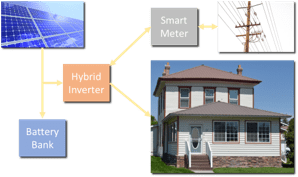
Hybrid solar systems are self-sustaining household electrical systems that also connect to your local power grid. They connect via a smart meter to provide net metering. That means, these systems provide three sources of electricity: solar power, battery bank power, and power from your local electrical grid.
Your solar panels provide power by converting sunlight into free electricity. Then, your battery bank stores excess electricity for nighttime use. Next, your local power grid connection provides extra power when needed. Finally, your grid connection allows you to sell excess electricity right back to them for a credit.
Keeping your connection to your power grid allows you to receive unlimited electricity. That means, if you use big equipment or appliances, your electrical system will support it without fault. And if the summer heat steeply rises, use air conditioning to your heart’s content and stay cool throughout the day.
Many solar system variations and custom options exist. And, there’s an assortment of essentials to identify ahead of time. Then, you can design your solar system. Keep in mind, it’s important to understand the basic system and components before installation.
As a complete system, hybrid solar components work together to power your household without interruption. Also, they greatly reduce your electric bill by allowing you to sell your excess electricity right back to your utility company for a credit, as mentioned earlier.
To see why hybrid solar systems stand well above the rest, check out HYBRID SOLAR: Uncover the advantages of staying tied to the grid.
For the best ways to get financing for your solar system purchase, see FINANCING FOR SOLAR PROJECTS: Uncover best financing options.
Solar system battery bank for backup
Your battery bank provides complete electrical independence – it makes off-grid solar systems possible. To explain, it provides power at night when your solar panel array isn’t producing. Also, it provides extra power in those moments when power consumption spikes above what your solar panel array provides.
As you know, if you don’t have a grid connection, you need a reliable way to store the solar energy generated during the day for later use. Therefore, it’s critical to have a battery bank to store enough energy to get you through each night. Also, it must support off-peak production times like cloudy days.
Traditionally, lead-acid deep cycle battery systems were the most common and reliable option for off-grid solar systems. Though a proven technology lasting over a decade, keep them at room temperature and don’t discharge them often. To explain, high temperatures, low temperatures, and fully draining lead-acid batteries internally damages and degrades them.
Lithium-ion solar system battery bank option
Your best battery option for solar system backup power is the lithium-ion battery bank. It’s an advanced storage device optimized for long lifespan, fast recharge, and high efficiency. Most notably, they’ve become extremely popular for their high efficiency ranging from 92% to 98%.
Lithium-ion battery banks are compact, lightweight and scalable. On top of that, they provide flexible sizing for additional capacity down the road. In other words, add lithium-ion batteries in the future as you’re power needs increase. Or, add them to increase power storage for more peace of mind.
One great advantage of lithium-ion battery banks are their ability to sustain a low or partial charge levels for prolonged periods without negative effects. Compare this to sulfation that is a common problem with lead-acid batteries. Also, lithium-ion batteries provide high charge rates – charge times are up to 70% faster than lead-acid.
Solar system BACKUP GENERATOR
A fully self-sufficient solar systems with an ample battery bank provides backup power at night and during power outages. But unless your battery banks are huge, they may not pack enough punch for power-hungry air conditioner, pumps, or store enough energy to run your entire household for long periods of time – days or weeks of stormy weather for example.
Comparing generators to batteries is a case of apples and oranges. Each of these are considerable investments, but if energy independence and uninterrupted power is your goal, both are recommended. Now that we’ve covered battery banks, let’s focus on having a solar system backup generator.
Portable vs. standby solar system backup generator
Portable generators and home standby generators do the same basic tasks. But the two types are quite different when it comes to cost and performance. Both can handle the essentials, so your decision comes down to power, price and convenience.
Portable models tend to be noisier and to produce less power than standby models. Also, unless permanently connected, they must be wheeled out of storage, connected to your circuit breaker, and manually started.
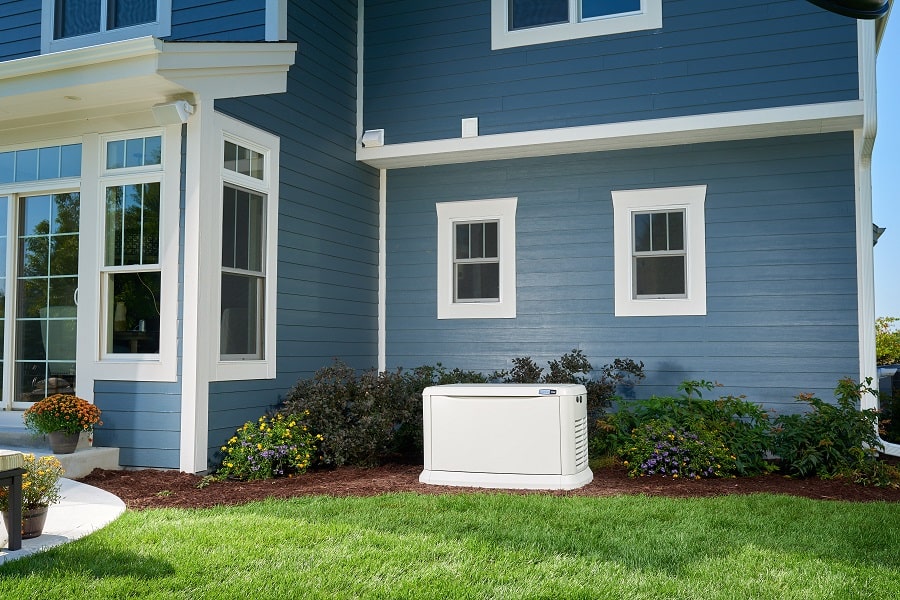
Home standby generators and whole-house generators are professionally and permanently installed outside your home. As such, they have an insulated weatherproof housing that keeps them relatively silent. Also, they turn on automatically when the power goes out and power your entire household.
Some home backup generators run on your existing natural gas or LP fuel supply. That means, save the gas cans for your outdoor gas powered equipment.
Solar system backup generator power ratings
Generators are sold by power output measured in Watts. The amount of power they deliver determines how many appliances and other electronics they’ll handle at once. For a typical household, plan on at least 5,000 Watts of output power.
The delivery and quality of power from a solar system backup generator determines how well it’ll run. For example, a generator with a high output that struggles with power delivery or quality might stall or trip a circuit breaker when it’s bogged down. Therefore, read specs and reviews before making a purchase.
Solar system backup generator transfer switch
A solar system backup generator transfer switch safely connects your standby or portable generator to your circuit panel via one cable. Without it, you’ll need to use extension cords, which can be dangerous and messy. In other words, a transfer switch is much more convenient and safe.
Getting your solar system installed
First, never attempt to install your own solar system unless properly trained, experienced, and correctly certified to do so. In other words, this type of installation is not a DIY project. To explain, solar component installation and wiring requires an electrician and a construction contractor to do it right.
For a comparison, installing a complete solar system is like installing a circuit breaker unit along with other major electrical systems. One primary component of a solar system is the solar power inverter, which powers your entire home. That means, safety and reliability is no different between the two.
Construction skills are also necessary to install a solar system. To elaborate, solar panel arrays are typically secured on top of existing structures. As such, the physical connections must be strong and reliable. Sometimes, a structure is built from the ground up to carry the load of your solar panel arrays sufficiently.
Narrow down certified solar installers near me
Starting with a solid definition, the Bureau of Labor and Statistics states that “Solar installers assemble, set up, and maintain rooftop or other systems that convert sunlight into energy.” Though quite a simple definition, that defines exactly what they will do for you.
To learn how to find the best solar system installer near you, check out: SOLAR INSTALLERS NEAR ME: How to pick a great solar installer
For some great information on how to maintain your solar panels, be sure to read Maintaining solar panels and solar systems REVEALED.