
If you’re thinking about adding solar power to your home, solar net metering will help you finalize your decision. With solar net metering, sell excess electricity produced by your solar panels back to your utility company. That means, you profit when your solar system becomes a source for your local electrical grid.
For another way to look at net metering, think of your local electrical grid as a battery. During daylight hours, most solar systems produce excess electricity. Solar net metering uses your electrical grid to store that surplus as a credit. After the sundown, your household uses that credited power – free electricity.
To learn more about solar net metering and how it benefits you financially, continue reading…
Solar net metering helps the local grid
By supplying a smoother electrical-demand curve, solar net metering helps utility companies manage peak electrical loads in your neighborhood. As such, it reduces strain on power grids by preventing energy losses in long-distance electrical-current transmission and distribution.
To briefly explain energy loss, the longer the distance electricity travels, the more energy it looses. Therefore, supply electricity to your neighbors to greatly reduce that distance. In the end, solar net metering saves money for you and utility companies by reducing their electrical loss – win, win!
Uncover how solar net metering works
With solar net metering, you’re only billed the net of what you take from the grid after using your credits. To simplify it, you supply the grid during the day when you’re at work. Then, you use electricity from the grid at night. When you use more than you supply, the difference becomes the net amount you owe.
If you calculate the size of your solar system correctly, you’ll produce enough electricity to match your household electrical needs. However, the amount of electricity your solar panels produce will vary throughout the year – sunny vs. cloudy seasons. Also, the angle of the sun changes throughout the year.
When you understand your daily and yearly power rhythms or usage curves, your family’s energy consumption comes into light. Then, you can plan for an efficient and reliable system. Using your household power usage data, calculate the adequate size of your solar system accurately.
Hybrid solar systems use solar net metering – they are self sufficient and tied to the grid. And, solar net metering balances those seasonal differences in solar energy production throughout the year. Get a credit for the excess electricity your solar panels produce and use your credit at a later date.
See the purpose for solar net metering
There are two primary purposes for solar net metering. The first purpose is to encourage adoption of solar power. For the second purpose, utility companies greatly benefit from the influx solar energy onto the grid as mentioned earlier – this influx saves them money by reducing energy loss.
Solar energy sent to the grid also helps utility companies balance the cost of purchasing electricity from other resources. This is especially true during hot summer months when electricity is often the most expensive. Most homes will produce excess electricity during those summer months.
Since these energy-production variations are fairly predictable, your utility company won’t send you a monthly check when you produce more than you need. Instead, you will build up those credits during the summer months so you can draw from them at night and during the winter.
Design your solar system for yearly power usage
With the right solar system designed for yearly power usage, it will generate enough power to match your total electricity use for a year. That means, your electricity will be completely free. As such, as your solar system generates excess electricity, you receive credits based on net kilowatt-hours sent back to the grid.
On the flip side, if you produce less electricity than you use, you’ll be billed by your utility company to pay the net difference. In that case, you must pay for the electricity you use beyond the excess electricity your solar panels generate. In both cases, solar net metering handles the net difference.
Smart meters provide net metering
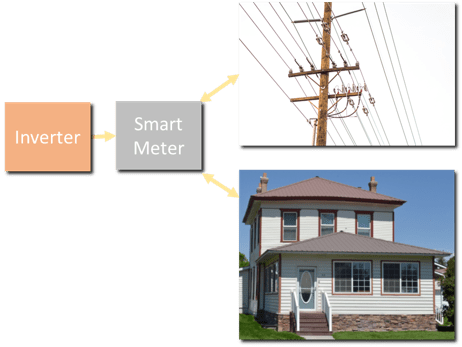
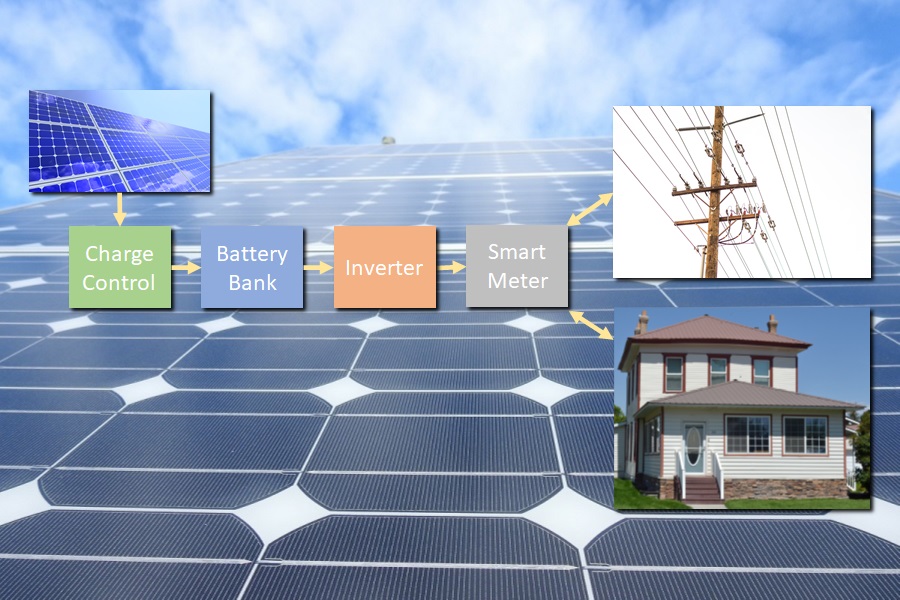
As a replacement to your standard meter, a smart meter provides you with something called net metering. For an explanation, net metering analyzes and displays your local power grid’s electrical exports and imports to and from your solar system.
Smart meters manage additional factors too. To explain, they handle both the power generated by your solar system and your household power consumed. When exporting electricity, your meter spins backward. As a result, your electric bill receives applied credits each month.
Just get solar net metering and save
Solar net metering is the best way to go since it allows you to store the excess electricity you produce and use it at a later date. In fact, thanks to solar net metering, you will save tens of thousands of dollars over the lifetime of your solar system by offsetting your need for electricity from the grid.
While solar net metering is not the only way utilities compensate homeowners for going solar, it’s by far the most common and effective way to go. Check out the DSIRE or Database of State Incentives for Renewables and Efficiency to learn more. The DSIRE tracks net metering and provides other policies.
Economic benefits: Jobs & investment
Solar net metering provides substantial economic benefits in terms of jobs and investment. It also increases demand for solar energy. Thus, it creates jobs for the installers, electricians, and manufacturers within in the solar product supply chain. Today, the solar industry employs over 230,000 U.S. workers.
The financial benefits of going solar
There are many financial benefits to gain from solar systems that offset upfront system costs. First, receive tax credits from the US Government. This year, the tax credit is 26% of your total solar assets and installation cost. Unfortunately, it will drop to 22% in 2023 and the future of it is unknown after 2023.
Gain an increase to the value of your home after installing your own solar system. When you do, you’ll be able to sell your home faster. Also, you’ll get considerably more for your home – your home appraisal will go up greatly. Finally, solar systems provide a hedge against inflation, just as home ownership provides.
Finally, get higher monthly rent when leasing your home. First, this comes from your increased home value. Also, the greatly reduced or eliminated electric bill offers an attractive justification for increased rent. Finally, when you add the environmental factor of solar power, your potential renter pool increases.
Use only highly-trained solar installers
Make sure you never try to install your own solar system unless you’re properly trained, experienced, and correctly certified. In other words, solar installation is not a DIY project. In fact, solar component installation and wiring requires an electrician and a construction contractor to do it right.
Installing a complete solar system is like installing a circuit breaker unit along with other major electrical systems. One primary component of a solar system is the solar power inverter, which powers your entire home. That means, safety and reliability is no different between the two.
The ability to perform construction is also necessary to install a solar system. Since solar panel arrays are typically secured on top of existing structures, the physical connections must be strong and reliable. Additionally, structures are sometimes built from the ground up to carry the load of your solar panel arrays sufficiently. Therefore, if you’re not familiar with construction, do not attempt solar installation.
To learn how to choose a great solar installer near you, check out this informative article:
SOLAR INSTALLERS NEAR ME: How to pick a solar installer to do it right