
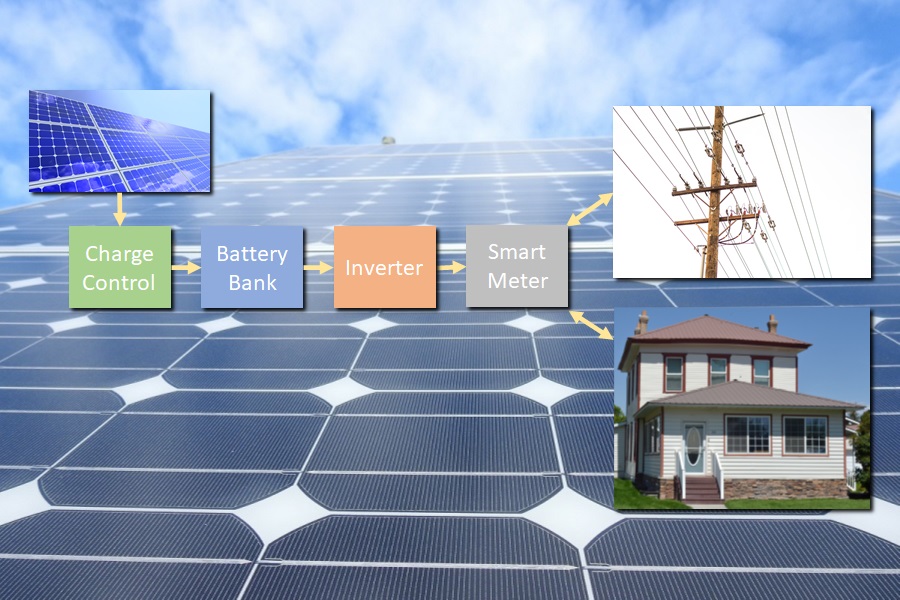
Why do you need a multi-mode inverter for your solar system? Its primary purpose is to convert the DC or Direct Current produced by your solar panels and batteries to 120V AC or Alternating Current for your household. These two currents are different and completely incompatible.
The secondary purpose of a multi-mode inverter is to charge and maintain your battery bank. To explain, it charges your batteries and manages battery charge levels in order to prolong battery life. Now, continue reading to uncover how a multi-mode inverter works and how it fits into your solar system.
Where your multi-mode inverter fits in
A sufficient solar system is a self-sustaining household solar system that also connects to the power grid. That means, it provides power from three sources: solar energy, battery bank backup, and your electrical utility grid. As such, it takes a powerful multi-mode inverter to handle all three power sources well.
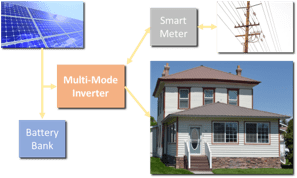
On the DC end of your multi-mode inverter, it connects to your solar panel array and battery bank. Then, it connects to your house and power grid on the 120V AC end. To be specific, it connects to the power grid through your “smart meter.”
Although your multi-mode inverter connects to your power grid, it functions as an off-grid solar inverter when your local power grid goes down. That means, it uses your solar panel array and your battery bank together to provide continuous household power while there’s a power blackout in your area.
In order to provide that continuous household power, your multi-mode inverter must support very large loads. Examples include air-conditioners, water pumps and heaters. That means, multi-mode inverters don’t require separation of essential loads and non-essential loads.
Clean multi-mode inverter AC power
Producing clean 120V AC power is the name of the game when it comes to quality multi-mode inverter output. When you look at the electricity provided by a power grid, the electrical waveform shows up as a pure 60hz sign wave. This waveform alternates between positive and negative 60 times per second.
If the AC waveshape is smooth, current draw from appliances is smooth as well. This affects efficiency, power-supply temperature, and power-step response, like when the refrigerator compressor turns on. In simple terms, it allows equipment to operate under optimal conditions and provides much longer life.
Do you use audio equipment? If so, a quality power inverter is a must. Cheaper multi-mode inverters produce a jagged 60hz waveshape. Those reduce the aspects mentioned earlier and they produce noise. Audio must be clean and noise free. Therefore, pay the extra expense of a quality multi-mode inverter.
How to select a multi-mode inverter
Modern hybrid solar and off-grid solar energy storage systems have many specifications to consider before selecting and sizing your multi-mode inverter. There are now many different system types available to choose from.
The different types include grid-interactive inverter-chargers, hybrid inverters, complete systems with integrated battery storage or BESS and AC-coupled battery systems. AC or DC coupling refers to how your solar panel array is coupled or linked to an energy storage or battery system.
Regarding surge or peak power ratings, they’re critical for off-grid systems but not always important for hybrid systems. When powering high-surge current appliances such as compressors, water pumps, power tools, and washing machines, your multi-mode inverter must be able to handle those high surge loads.
The battery inverter max charge rating, measured in Amps, is considered to ensure the battery bank capacity. Also, your multi-mode inverter must be balanced correctly to ensure the inverter-charger has enough charging capacity. This enables the battery to reach the absorption charge voltage.
Multi-mode inverter breakdown
Solar systems consist of solar panels along with various other components. When you consider solar panels to be the heart of your solar system, then the multi-mode inverter is the brain. Multi-mode inverters help in tracking the electrical supply and they store the excess electricity in your battery bank.
Solar panel array – free electricity!
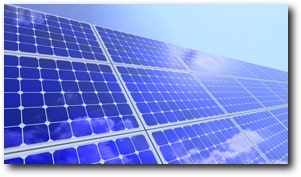
Each solar panel within your solar panel array contains cells that are photo-voltaic. They’re connected in a framework to generate DC electricity. Amazingly, solar panels generate this power from the photons within sunlight.
When you’re connected to the grid, your multi-mode inverter synchronizes the frequency of the grid and inverter power to match the frequency for smooth operation. Multi-mode Inverters are generally classified as conventional transformer-based inverters or transformer-less inverters.
Transformer-based Inverters EXPLAINED
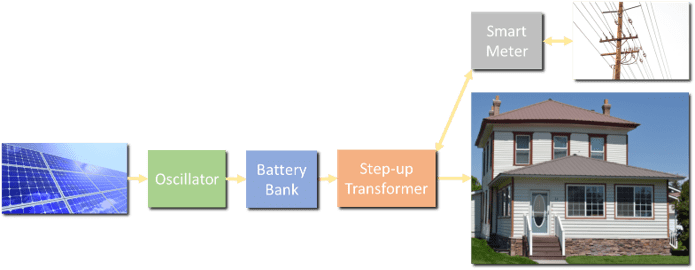
A conventional multi-mode inverters is built with a transformer to synchronize the voltage of the grid and your household load. Then, the generated DC is converted into AC with the help of an oscillator and metal oxide semiconductor field-effect transistor or MOSFETs. Finally, the AC power is matched with the frequency of the grid/load with the help of a transformer.
Traditional multi-mode inverters suffer from transformer losses. That means the efficiency is decreased. Also, the weight of these inverters is high leading to increases in transportation and installation expenses. To overcome these losses transformer-less multi-mode inverters are gaining in popularity.
Transformer-less Inverters REVEALED
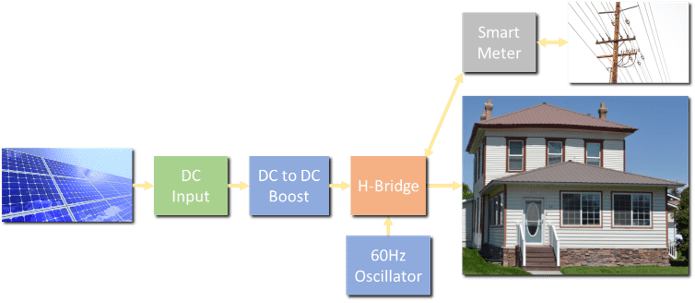
Today, transformer-less multi-mode inverters are becoming popular. As no extra transformer is required, they decrease the extra weight, expense, and size. This sort of multi-mode inverter is more productive as the misfortunes caused by the transformers are overcome – the efficiency is practically 97%.
This type of multi-mode inverter uses a computerized multi-step process. As such, it converts the DC output of solar panel into high-frequency DC using a boost converter. Also, it’s converted into AC as per the grid and load requirement using an H-Bridge converter and oscillator.
Finally, the DC boost converter replaces the traditional step-up transformer. That means, it reduces the losses and space requirements.
Maximum Power Point Tracker or MPPT
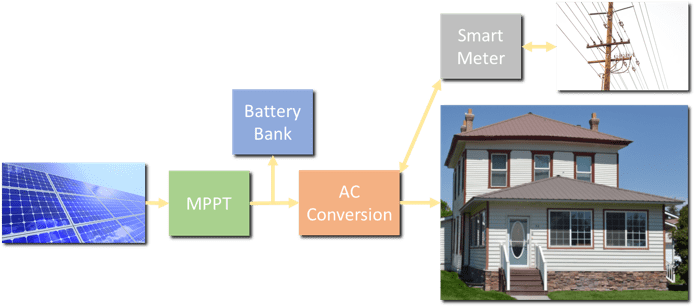
The solar panel array has a limited DC supply and it varies throughout the day depending on the sunlight. To extract maximum possible power from the sun, a technique known as maximum power point tracking is used within your multi-mode inverter.
MPPT is simply just a DC to DC converter. The MPPT circuit within your multi-mode inverter constantly detects the solar panel array DC voltage and current. Then, it adjusts the setting to extract maximum power and drive your multi-mode inverter at the maximum possible efficiency.
If the solar panels within your solar panel array are mounted across the roof area in different directions, multiple MPPTs are needed. This is due to the amount of sunlight falling on each panel being different.
MPPT multi-mode inverters are classified as single or dual inverters. Dual MPPT inverters are advantageous as they connect two or more strings without the need for a combiner box. Also, they efficiently handle different tilt angles, azimuth angles, and voltage and power differences.
Systems using multi-mode inverters
There are two types of solar systems that use multi-mode inverters: hybrid solar systems and off-grid solar systems. And, there are many similarities between the two. The primary difference is hybrid solar systems connect to the power grid and off-grid solar systems do not.
While both solar system types support household electricity independently, off-grid solar systems operate in this mode indefinitely. Therefore, they require much larger battery banks to support household power for long periods of time. Also, off-grid solar systems may require a solar system backup generator.
Hybrid solar systems EXPLAINED
A hybrid solar system is self-sustaining. And, it’s a self-sustaining electrical systems also connected to your local power grid. To elaborate, it provides three sources of electrical power: solar power, battery bank, and your local electrical grid connection.
The advantage of using your local electrical grid connection is it provides power when you need it. On top of that, sell back excess power produced by your solar system. To explain, your hybrid solar system becomes a “source” of power for your city.
Using a smart meter and a process called net metering, you receive credits for that excess electricity you provide. This greatly reduces your bill and sometimes provides a net profit. That means, households that use less electricity than hybrid solar systems generate each month get paid with credits.
Hybrid solar systems ensure you’ll always have power, no matter what. To explain, your house will have reliable power regardless of the weather or power outages in your region. That means, peace of mind is your number-one benefit from this self-reliant household electrical setup.
Off-grid solar systems REVEALED
There are quite a few variations and custom options available for off-grid solar systems. As such, we’ll identify and detail the assortment of essentials in simple terms. Now, let’s walk through each part to see the basic system. Then, check out what essential solar components go into it prior to installation.
Before preparing your off-grid solar system, you must determine the amount of energy you and your family require. Off-grid solar systems are inherently variable – day vs. night and sunny vs. cloudy. As such, calculate both your daily energy usage and your usage throughout the year in detail.
The need to identify your daily and yearly power rhythms or usage curves of your family’s energy consumption is essential. This ensures an efficient and reliable system. Therefore, using your household power usage data, solar component size for your entire solar system will be adequate and accurate.
Keep this in mind: choosing to use an off-grid solar system requires lifestyle changes. Talking with off-grid solar system users reveals one thing. Off-grid power requires reevaluation and adjustment to your relationship with energy. Of course, they all say they live better lives because of it.
To calculate the adequate size of your solar system, check out: OFF-GRID SOLAR CALCULATOR: How to calculate an off-grid solar system size.
Complete solar system installation
Never attempt the installation of your own solar system unless properly trained, experienced, and correctly certified to do it. In other words, this installing a solar system isn’t a DIY project. Solar component installation and wiring requires an electrician and a construction contractor to do it right.
To compare, when you install a complete solar system, it’s like installing a circuit breaker unit along with other major electrical systems. As such, there is no difference between the two regarding safety and reliability. The safety of your family depends on your installation being done right.
Installing a solar system requires construction skills as well. For example, solar panel arrays are normally connected to the top of existing structures. As such, those physical connections must be strong and reliable. Also, structures are sometimes built from scratch to carry the solar panel array load sufficiently.
Regarding certifications, the Office of Energy Efficiency & Renewable Energy states that “Industry-standard certifications are awarded through organizations like North American Board of Certified Energy Practitioners (NABCEP).” These are the gold standards among renewable energy system installers.
To uncover how to find the best solar system installer in your area, check out SOLAR INSTALLERS NEAR ME: How to pick a great solar installer.