


FACT: According to SEIA (Solar Energy Industries Association), more than 2M Americans now use solar. On top of that, they forecasted solar installations to double by 2023. There’s a good reason for this – solar is a great investment! But cost is the only hurdle. Therefore, uncover how to receive financing for solar projects – your best solar financing options.
In this article, you’ll not only discover ways to receive financing for solar projects, but you’ll also see how to reduce the cost. Then, receive great advice on solar system types, solar system calculations, and solar system installation. Now, read on to get the facts.
History of financing for solar projects
Before lenders could offer conventional financing for solar, they needed to see real value of the technology. Good lenders were not willing to provide appealing financing options yet. As such, it took a few giant feats to prove to the lending community that financing for solar projects was a low risk venture.
SunEdison received venture capital financing for solar projects at Staples
As the first giant feat proving the effectiveness of solar investment, SunEdison offered to install solar systems at many Staples’ locations for free. Then, they would charge Staples for the electricity. To entice them, they offered electricity rates that were lower than those offered by the local utility companies.
Once Staples had approved SunEdison’s appealing solar installation offer, SunEdison had to acquire solar financing to cover the cost. At the time, conventional solar financing didn’t exist. Therefore, they pursued venture capitalists like Chargers Retirement Fund and others to bankroll this big commercial solar project.
SunEdison finally received conventional financing for solar projects at Walmart
After the great success of their solar venture with Staples, SunEdison made the same deal with Walmart. The problem was, the many Walmart locations required an investment of $750M USD. In order to finance that, with their proven track record, they were able to secure financing with Goldman Sachs.
Prior to loan approval, Goldman Sachs looked at the primary variables involved in this solar venture. First, they reviewed the “net metering.” Then, they looked at tax incentives. After that, Goldman Sachs reviewed pricing stability and technology stability. Finally, they approved and financed the entire deal.
Over the period of about four years, between 2011 and 2015, Goldman Sachs financed similar commercial solar projects throughout the United States. As examples, commercial solar systems were installed at Costco, IKEA, and FedEx with great success.
Conventional residential financing for solar projects
Now that solar-system value was proven on a grand scale, local banks stepped up to offer conventional loans for solar. To list a few, banks like Bank of America, Key Bank, Citibank, and Wells Fargo competed to offer good loan options for residential solar projects.
By offering lower interest rates and 20 to 25 year loan terms, monthly payments are typically 33% less than monthly electric utility payments. And, those payments are stable – they never go up. As you know, electricity rates from utility companies are always on the rise.
In the following video, Eric Martineau, the founder and owner of Just Get Solar, reveals the facts about financing solar projects in great detail. As you’ll see, he really knows his stuff!
Next, see the great financial benefits you’ll receive when going solar.
Financial benefits of solar assets
There are many financial benefits to gain from solar systems that offset upfront system costs. First, receive tax credits from the US Government. This year, the tax credit is 26% of your total solar assets and installation cost. Unfortunately, it will drop to 22% in 2023 and the future of it is unknown after 2023.
Gain an increase to the value of your home after installing your own solar assets. When you do, you’ll be able to sell your home faster. Also, you’ll get considerably more for your home – your home appraisal will go up greatly. Finally, solar systems provide a hedge against inflation, just as home ownership provides.
Finally, get higher monthly rent when leasing your home. First, this comes from your increased home value. Also, the greatly reduced or eliminated electric bill offers an attractive justification for increased rent. Finally, when you add the environmental factor of solar power, your potential renter pool increases.
More financial savings from solar systems
Sunlight is free, and the energy you can produce from that sunlight is almost endless. That being said, installing an effective and sufficient home solar system costs money. But, the money-saving benefits always come through in the end. As such, solar is an investment that really pays off.
To save even more money, use a solar system broker like Just Get Solar. Being an equipment broker, Just Get Solar removes the middle man, saving you those large commissions of 25% to 35%. On top of that, they get you the best equipment at the best prices. Also, they provide the best loan rates, saving you even more.
Regarding your electricity bills, prices go up regularly. Compare that to monthly payments on your solar system loan. Since loan payments don’t go up, you’ll save more and more over time. Then, those monthly bills will end once paid in full. That means, your monthly expense will end if your solar system is self sufficient.
Home solar increases home value
There is solid evidence that home solar assets increase home value. This is shown by both home appraisals and home resale closing prices that were studied. Let’s start with a few sources so you can read and confirm these findings for yourself. Two of the following articles require a simple signup to read the entire article. These are the links:
In the first article – an academic work, it states that the research analyzes a large dataset of California homes that sold from 2000 through mid-2009 with solar installed. The analysis finds strong evidence that homes with solar systems sold for a premium over comparable homes without. Great news!
The second article reveals a prospective model developed to determine the value of solar. That can be directly translated into how solar increases home value for resale. They use an income capitalization approach that considers the present value to determine the future value of a solar system.
Finally, the third article how a solar system adds value to your assets – your home. Read it to see their research from several building owners and managers. It reveals how they made the business case for solar and found increased asset values during appraisal or at the time of sale – resale.
Receive solar energy independence
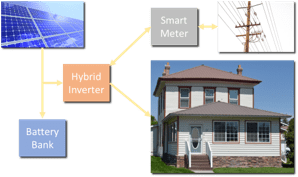
The center of both a hybrid solar system and an off-grid solar system is a multi-mode inverter. First, this converts DC or direct current from your solar panel array and battery bank to 120V AC or Alternating Current to your house. Then, it charges and manages your battery bank to prolong battery life.
Since the peace of mind that comes from solar energy independence and unbroken electrical assurance is undeniable, let’s look deeper. To begin, solar energy independence normally comes from off-grid solar systems. But if your home is connected to the power grid, a hybrid solar system is your best option.
Brief explanation of solar assets within a system
Your solar panel array contains photo-voltaic cells mounted together in a framework. To generate electricity, these panels use energy from sunlight called photons to generate DC electricity.
Hybrid solar inverters, also called multi-mode inverters, perform two functions. First, they convert DC from your solar panel array and battery bank to 120V AC for your household. Then, they manage battery charge levels to prolong battery life.
Solar energy independence from off-grid solar
Starting with off-grid solar systems, over 300,000 homes use them for solar energy independence around the world. They know that when connected to the grid, they’re dependent on an external supplier, the utility company, for all their power. And when that power grid goes down, so does their power supply.
There’s a balance between your off-grid solar system size and your electrical needs. In order to provide true unbroken solar energy independence, your battery bank must be quite large. It must get you through long periods of little to no sunlight. Also, a backup generator may be needed depending on your region.
Solar energy independence from hybrid solar
When referring hybrid solar assets, you’re talking about a self-sustaining household electrical system that is also connected to your local electrical grid. That means, this system provides three sources of electricity: solar power, battery bank power, and power from your local electrical grid.
Keeping your connection to your power grid allows you to receive unlimited electricity. That means, if you use big equipment or appliances, your electrical system will support it without fault. And if the summer heat steeply rises, use air conditioning to your heart’s content and stay cool throughout the day.
Calculate your solar system size
You can find a good off-grid solar calculator online, and we provide one too. But here, we’ll break down exactly what goes into that calculation. Knowledge is powerful, so equip yourself here before you buy an off-grid or a hybrid solar system. Read on to uncover how to calculate your off-grid solar system.
Determine your total home power usage
Before you use an off-grid solar calculator, it’s critical to determine the amount of energy you and your family require. As such, calculate your daily energy usage throughout the year in detail. The reason for this is simple: off-grid solar systems are inherently variable – day vs. night and sunny days vs. cloudy days.
When you understand your daily and yearly power rhythms or usage curves, your family’s energy consumption comes into light. Then, you can plan for an efficient and reliable system. Using your household power usage data, calculate the adequate size of your off-grid solar system accurately.
Although your household energy usage varies throughout the year, calculate the basics in kWh (kilowatt hours). To begin, water usage, appliance usage, and general electricity usage is where to start. Keep in mind, only calculate water-usage if you use an electric water pump to provide water to your household.
Your home appliance power usage in kWh
According to Energy.Gov’s article about estimating appliance and home electronic power usage, estimate total electricity used by your appliances with the following four methods:
- Review each Energy Guide label to estimate the individual unit’s average energy consumption.
- Use an Electric Consumption Meter to uncover how much electricity each appliance consumes.
- Install a whole-house energy monitoring system to monitor your actual energy usage.
- Calculate your total annual energy consumption using the formulas shown below.
Calculate your water pump power usage
If you use a water pump, check your water pump’s wattage – it’ll vary from 250W to 1,100W. Then, take the wattage of your specific water pump and multiply it by the number of hours per day that it runs. Next, multiply that by the number of days per year it runs. Finally, divide by 1000 for the amount of kWh used by your pump.
Calculate your annual energy consumption
To accurately determine your annual energy consumption, calculate each appliance individually. As such, use the wattage value for each of your own electrical appliances and products. This will provide the most accurate estimate. Then, add them all together to calculate your total annual energy consumption.
Start by estimating the number of hours per day each electric appliance and product runs throughout the day. For example, estimate the number of hours you use each electronic device. Examples include TVs, computers, gaming systems, home audio, and so on. Then, calculate each based on the wattage stated on each label.
Determine your daily energy consumption by using this formula: (Watts × Daily hours used) ÷ 1000 = Daily kWh of consumption.
Calculate your annual energy consumption by using this formula: Daily kWh of consumption × Number of days used per year = Annual energy consumption.
According to the U.S. Energy Information Administration:
“In 2020, the average annual electricity consumption for a U.S. residential utility customer was 10,715 kilowatthours (kWh), an average of about 893 kWh per month. Louisiana had the highest annual electricity consumption at 14,407 kWh per residential customer, and Hawaii had the lowest at 6,446 kWh per residential customer.”
Check out this informative article to learn exactly how to calculate what must go into your solar system:
OFF-GRID SOLAR CALCULATOR: How to calculate an off-grid solar system size
Solar system installation after financing for solar projects
To begin, never attempt to install your own solar system unless properly trained, experienced, and correctly certified to do so. In other words, this type of installation is not a DIY project. To explain, solar component installation and wiring requires an electrician and a construction contractor to do it right.
As a comparison, installing a complete solar system is like installing a circuit breaker unit with other major electrical systems. One primary component of a solar system is the solar power inverter, which powers your entire home. That means, safety and reliability is no different between the two.
Also necessary to install a solar system are construction skills. It requires skills to secure solar panel arrays to the top of existing structures. As such, those physical connections must be strong and reliable. Sometimes, structures are built from the ground up to sufficiently carry the load of those panels.
To find out how to find a great solar system installer, check out this detailed article:
SOLAR INSTALLERS NEAR ME: How to pick a solar installer to do it right