


In Mexico, all electric power from the grid is supplied by the Federal Electricity Commission or CFE. It currently operates throughout Mexico with more than 93,000 employees. And it’s organized into four aspects: electricity generation, transmission, distribution and providing basic services.. But now, electricity cost rising in Mexico has motivated many Mexicans to install home solar systems.
Last year, CFE lost 40% of its high-consumption residential customers. This was due to more and more people installing solar power systems. They want to avoid paying the rising electricity costs in Mexico. To be specific, it lost 110,453 high-electrical-consumption accounts in 2021.
Now, read on to uncover why electricity cost rising in Mexico provides motivation for solar throughout the country.
CFE announces electricity cost rising in Mexico
Back in February, CFE announced that there has been an increase in electricity rates. This is caused by the increase in gas prices from Texas. According to the Mexican Energy Regulatory Commission, there will be a slight increase to residential electricity cost.
As they specifically stated, residences with electrical consumption of less than 2,000 kilowatt-hours per month. Those homes must be in cities with a minimum average temperature of 32 degrees Celsius during the summer. And, they will only have a slight increase as electricity cost is rising in Mexico.
As you probably guessed, there are only two ways high-electrical-consumption customers can avoid paying the CFE’s rising rates. The first way is to reduce their electricity use below 2,000 kilowatt-hours per month. The, the other way is to install a home solar power system.
In the information shared by the director of IMCO or the Mexican Institute for Competitiveness, they stated that in an effort to subsidize electric energy to consumers, CFE will require MX$66 billion (US$3.24 billion) in infrastructure investment. This will be in addition to the MX$73 billion (US$3.59 billion) budget.
To fulfill the remaining 54 percent of national electricity, the CFE will need to reactivate some of its old plants. This entails further investment that has not been considered by CFE. IMCO’s estimates report CFE will need an investment of MX$489 billion (US$24 billion) between 2022 and 2028.
How many Mexican homes installed solar?
As shown by data from the Energy Regulatory Commission, over 59,000 homes installed solar panels last year. This is a figure that accounts for 54% of the high-electrical-consumption customers the CFE lost. The other 46% presumably cut their electricity use and now pay one of the seven lower rates.
Data from CFE shows that high-electrical-consumption customers only made up 0.4% of the 41.5 million residential customers the utility had at the end of 2021.
How to design your solar system
In short, your solar system design is based on the number of kWh or kilowatt-hours your household requires per day. As such, that will determine how much energy your system must produce for you. You’ll need to calculate this carefully since your household energy demand will vary throughout the year.
There are two calculations that will help determine your household energy usage. First, calculate your energy consumption for each month of the year. If you are connected to the grid, just retrieve this info from your monthly electric bills or your annual summary. If not, we’ll walk through the steps one-by-one.
This info is important since solar panels produce different amounts of power at different times of the year. For example, your solar panels must produce enough kWh per day in December, the lowest solar production month of the year. Soon, we’ll determine your solar panel requirements as we walk through how to design a solar system.
Components of a solar system
While you may find many variations and custom options that go into a solar system, there’s an assortment of essentials to identify and explain in simple terms. As such, let’s take a walk through each part to understand the basic system and what essential solar components go into it prior to installation.
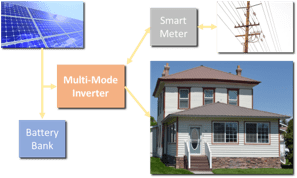
A sufficient solar system is a self-sustaining household solar system that also connects to the power grid. That means, it provides power from three sources: solar energy, battery bank backup, and your electrical utility grid.
Off-grid systems are enormously more complicated than common grid-connected solar systems. But, over 300,000 homes use them for their energy needs around the world. They know that when connected to the grid, they’re dependent on an external supplier for all their power. And when that power grid goes down, so does their power supply.
Check out the following components that make up a solar system. In this section, equip yourself with important knowledge while learning how to design a solar system. That way, you won’t run into surprises when purchasing you own off-grid solar system or hybrid solar system.
Solar panel arrays for free electricity
Solar panel arrays are frameworks of panels filled with photo-voltaic cells. They generate DC electricity from the energy projected by sunlight called photons. This process was first discovered by Alexandre-Edmond Becquerel back in 1839.
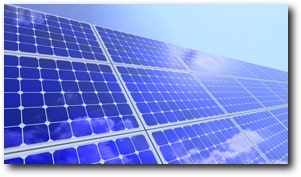
Solar panel arrays require direct sunlight to produce maximum power output. Even on cloudy days, solar panels absorb solar energy and produce power. But of course, power output reduces significantly by 25% to 40% compared to sunny days.
Panel efficiency deals with the electrical output of each panel: 320W, 290W, 270W etc. This translates into the number of panels you’ll need. To calculate, power rating divides by total panel area. That means, having a larger panel doesn’t always equate to higher efficiency.
Calculate household energy demand
Although your household energy demand varies throughout the year, start by calculating the basics in kWh. To begin, water usage, appliance usage, and general electricity usage is where to start. Keep in mind, only calculate water-usage if you use an electric water pump to provide water to your household.
If your household uses a water pump, check your water pump’s wattage – it will vary from 250W to 1,100W. Then, take the wattage of your water pump and multiply it by the number of daily hours it runs. Finally, divide that by 1000 for the number of kWh your pump uses.
Calculate each appliance individually. As such, use the wattage value for each of your own electrical appliances and products. This will provide the most accurate estimate. Then, add them all together to calculate your total annual energy consumption.
Estimate the number of daily hours each electric appliance and product runs at the most. For example, estimate the number of hours you use each electronic device. Examples include TVs, computers, gaming systems, home audio, and so on. Then, calculate each based on the wattage stated on each label.
Performing the household energy calculation
To determine your daily energy consumption, use the following formula:
(Watts × Daily hours used) ÷ 1000 = Daily kWh of consumption.
To calculate your annual energy consumption, use the following formula:
Daily kWh of consumption × Number of days used per year = Annual energy consumption.
This is a statement about annual electricity consumption in the U.S. by the U.S. Energy Information Administration:
“In 2020, the average annual electricity consumption for a U.S. residential utility customer was 10,715 kilowatthours (kWh), an average of about 893 kWh per month. Louisiana had the highest annual electricity consumption at 14,407 kWh per residential customer, and Hawaii had the lowest at 6,446 kWh per residential customer.”
Estimating home appliance power usage
In the following article from Energy.Gov about estimating appliance and home electronic power usage, estimate the total electricity used by your appliances with the following four methods:
- Review each Energy Guide label to estimate the individual unit’s average energy consumption.
- Use an Electric Consumption Meter to uncover how much electricity each appliance consumes.
- Install a whole-house energy monitoring system to monitor your actual energy usage.
- Calculate your total annual energy consumption using the formulas shown below.