


There are many reasons people choose to install a solar system. But, the number-one question they ask before buying is about savings. As such, they ask: “How much does solar power save on electricity bills?” It makes sense. You want to know how much you’ll save on your electricity bill before investing in solar.
When you install a solar system of your own, you’ll save money in a few ways. Therefore, we’ll walk through how installing and using solar power saves you money. Also, we’ll make sure you fully understand the answer to “How much does solar power save on electricity bills?”
Continue reading to uncover how much using solar power will save you on your electricity bills. Then, see the other ways you’ll save money when you install your own home solar system. Finally, learn a little about hybrid and off-grid solar systems and what to consider before choosing one.
The reasons why people choose solar
Believe it or not, there are benefits to solar that go beyond financial reasons. As an example, electrical independence is growing in popularity. That means, off-grid solar systems provide that total autonomy. Additionally, off-grid solar systems completely remove that electricity bill altogether.
Being the best option in solar, Hybrid solar systems ensure continuous power regardless of external factors. That means, you’ll maintain reliable power regardless of the weather and of local power outages. As such, peace of mind is always your number-one benefit when deciding to install a solar system.
Although there are multiple types of solar systems and many reasons to install them, one reason stands out. You’re looking to save money. As you’ll see, there are many ways to save money with solar and we’ll look at each of them. Also, let’s answer the question “How much does solar power save on electricity bills?”
Save money by using a solar system
Sunlight is free, and the energy you can produce from that sunlight is almost endless. That being said, installing an effective and sufficient home solar system costs money. But, the money-saving benefits always come through in the end. As such, solar is an investment that really pays off.
Fortunately, Uncle Sam will help cover your expense with a tax credit. Although the tax credit may end in a few years, it’s available now and covers 26% of your entire solar system installation. In 2023, that tax credit will shrink to 22%. Beyond that, the credits are unknown. That means, time is of the essence!
Another way to save money on solar is to use a solar system broker like Just Get Solar. As an equipment broker, Just Get Solar eliminates the middle man, saving you those large commissions of 25% to 35%. On top of that, they get you the best equipment at the best prices, saving you even more.
How much does solar power save on electricity bills?
This is where the rubber meets the road regarding solar power. The question “How much does solar power save on electricity bills?” is asked by everyone and for good reason. We want to generate our own power instead of paying a utility company to generate power for us. That saves money by design.
As you’ve seen on your electricity bills, prices go up every year. Compare that to monthly payments on your solar system loan. Obviously, loan payments do not go up and they eventually come to an end once paid in full. That means, you will no longer have an electric bill if your solar system is fully sufficient.
The amount you save on your electricity bills by using solar power is directly proportional to the sufficiency of your solar system. To explain, if the your solar system is big enough to provide for all your electricity needs, your electric bill will drop to zero. On top of that, some solar systems let you sell back your excess power.
In the next section, let’s take a look at hybrid solar systems. They can be completely self sustaining and they allow you to sell back excess electricity. In other words, they allow your home to become a power “source” for your local utility company. How cool is that?
Hybrid solar systems sell back excess electricity
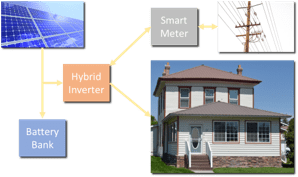
Introducing hybrid solar, a self-sustaining household solar system that also connects to the power grid. That means, hybrid solar systems provide power from three sources: solar energy, battery bank backup power, and electrical utility grid power.
With a hybrid solar system, the components work together to power your household without interruption. To explain, your solar panel array provides power by converting sunlight into free electricity. Then, your battery bank stores excess electricity for nighttime use. Finally, your local power grid connection provides extra power when needed it and allows you to sell excess electricity back to them.
The center of your hybrid solar system is a multi-mode inverter, which performs two primary functions. First, it converts DC or direct current from your solar panel array and battery bank to 120V AC or Alternating Current to your household. Then, it charges and manages your battery bank charge levels, which prolongs battery life quite well.
Hybrid solar inverters are also able to export or sell excess electricity back to your utility company. As mentioned before, your hybrid solar system becomes a “source” of power providing you with credits on your bill – another great response to “How much does solar power save on electricity bills?”
Watch this short video detailing the answer to “how much does solar power save on electricity bills?”
In the following video, Eric Martineau, the founder and owner of Just Get Solar, reveals detailed insight showing exactly how much using solar power saves you on your electricity bills. First, he quickly reveals the top 10 reasons people choose solar. Then, he focuses on how to save your hard-earned money.
The autonomy of off-grid solar systems
Off-grid solar systems are much more complicated than grid-connected solar systems, except for hybrid solar systems. That means, you must understand the inner workings of an off-grid solar system before making a purchase. Therefore, let’s take a look at what goes into planning an off-grid solar system.
Build an off-grid solar system requires a pre-understanding of the amount of energy your home requires throughout the year. As such, fully calculate your daily and yearly energy usage first. The reason for this is simple: off-grid solar systems are inherently variable – day vs. night and sunny vs. cloudy seasons.
Gaining an understanding of your daily and yearly power rhythms or usage curves is truly essential when planning an efficient, reliable, and self-sufficient system. As such, use your household power usage data to determine your solar component sizes throughout your solar system to be accurate and adequate.
Once your off-grid solar system is designed, the layout comes next. First, your solar panel array must be located correctly. To explain, the location must provide full maximum sun exposure. Then, your solar component and wiring are drawn into the plan. Once the plan is complete, you’re ready for installation.
Balancing between your solar component size requirements and your budget is crucial. When carefully considered, this balance will come to light and you’ll understand the minimum cost of your solar system. Most often, you won’t encounter surprises since industry standards account for these factors very well.