

Solar systems are becoming very popular, especially now that energy costs are rising fast. The idea is to reduce electricity costs and become energy independent. As such, gain an understanding of the various types of 48V solar systems. Then, uncover the amazing benefits of a 48V solar system for your home.
Achieving an understanding of what works best is your key to success. Therefore, this article provides that valuable knowledge to avoid a costly mistakes. And regardless of which system you choose, learn why a 48V solar system infrastructure offers great advantages over other types.
Now, read on to see how a 48V solar system infrastructure will provide great benefits and advantages.
See how a 48V solar system is different
When it comes to sizing a solar installation, there’s two main things to consider: watts and voltage. And, solar systems are rated based on how much energy they produce. To know how much power a system produces, you need to know both the system voltage and the output current.
The system that produces the most power is the one that produces the most current for a given amount of sunlight. Panels and inverters typically come in either 12V, 24V, or 48V solar system options.
As your need for electrical current goes up, the more resistance and heat your system will produce. To prevent tripped breakers, blown fuses, or even worse, a fire, you need a solar system that can handle that increased capacity without making it hazardous.
For both off-grid solar systems and hybrid systems – those connected to the grid, 48V solar systems provide full power for high voltage appliances that require many watts to run.
By using a 48V solar system, the configuration allows for a more direct energy path. As such, that reduces total power consumption. Therefore, all you must be concerned with is configuring the wiring between every component in your solar system.
How the 48V solar system is the future
A 48V solar system provides high power without compromising on quality or design. In fact, 48V solar system components are usually much higher quality. And since they are more efficient, they deliver higher power by nature.
As more and more consumers realize this, 48V solar systems become the norm.
48V solar system advantages
The advantage of a 48V solar system is simple: much less current is required to get the same power. In other words, at 48V, the current drops to a more reasonable amount while still delivering the equal wattage to your home. This makes efficiency go way up, allowing more power from the same sunlight.
Since 48V systems run at higher efficiency while using fewer amps, they can operate appliances more safely than lower voltage systems. A 48V system will not have to increase its amperage regularly to provide the same power level as a 12V or 24V system.
To conclude, 48V systems don’t need to increase the current to appliances as frequently. That means, they don’t need as much backup power from battery banks. Also, they don’t require as much cabling and don’t need cables to be heat-resistant, making them much less expensive.
See the two types of solar systems
Two primary types of 48V solar systems are available to choose from: hybrid solar systems and off-grid solar systems. But as you’ll see, there are many similarities between the two. The primary difference is hybrid solar systems connect to the power grid and off-grid solar systems do not.
As both 48V solar system types support household electricity independently, off-grid solar systems operate in this mode indefinitely. Therefore, they require much larger battery banks to support household power for long periods of time. Also, off-grid solar systems may require a solar system backup generator.
Solar energy independence from off-grid solar
Starting with off-grid 48V solar systems, over 300,000 homes use them for solar energy independence around the world. They know that when connected to the grid, they’re dependent on an external supplier, the utility company, for all their power. And when that power grid goes down, so does their power supply.
When preparing your off-grid 48V solar system, you must determine the amount of energy your household requires. As such, calculate your daily and yearly energy usage. The reason for this is simple: off-grid solar systems are inherently variable – day vs. night and sunny vs. cloudy.
Knowing the daily and yearly power rhythms or usage curves of your family’s energy consumption is essential when planning an efficient and reliable system. Using your household power usage data, solar component size determination for your entire solar system will be accurate and adequate.
Knowledge of how power is used by your household is critical. For example, water pumps eat power fast. That means, showers, toilet flushing, and washing dishes drain power quickly. The steps to take are small, but mindful. When you understand these factors, small changes make all the difference
Solar energy independence from hybrid solar
When referring hybrid solar assets, you’re talking about a self-sustaining household electrical system that is also connected to your local electrical grid. That means, this system provides three sources of electricity: solar power, battery bank power, and power from your local electrical grid.
Keeping your connection to your power grid allows you to receive unlimited electricity. That means, if you use big equipment or appliances, your electrical system will support it without fault. And if the summer heat steeply rises, use air conditioning to your heart’s content and stay cool throughout the day.
48V solar system components revealed
There are many variations and custom options that go into a solar system. And, there’s an assortment of essentials to identify. Therefore, let’s take a walk through each part to understand the basic system and what essential solar components go into it prior to installation.
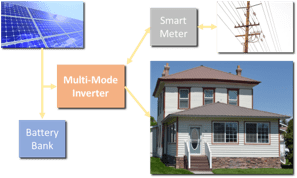
A sufficient solar system is a self-sustaining household solar system that also connects to the power grid. That means, it provides power from three sources: solar energy, battery bank backup, and your electrical utility grid.
It takes a powerful multi-mode inverter to handle all three power sources well.
Multi-mode inverter handles all household power
On the DC end of your multi-mode inverter, it connects to your solar panel array and battery bank. Then, it connects to your house and power grid on the 120V AC end. To be specific, it connects to the power grid through your “smart meter.”
Solar panel arrays provide free electricity
Solar panel arrays are frameworks of panels filled with photo-voltaic cells. They generate DC electricity from the energy projected by sunlight called photons. This process was first discovered by Alexandre-Edmond Becquerel back in 1839.
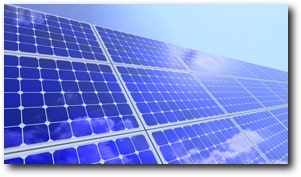
Solar panel arrays require direct sunlight to produce maximum power output. Even on cloudy days, solar panels absorb solar energy and produce power. But of course, power output reduces significantly by 25% to 40% compared to sunny days.
Panel efficiency deals with the electrical output of each panel: 320W, 290W, 270W etc. This translates into the number of panels you’ll need. To calculate, power rating divides by total panel area. That means, having a larger panel doesn’t always equate to higher efficiency.
Power optimizers maximize energy performance
Power optimizers maximize the energy harvest from your solar system. To explain, they achieve this by individually tuning the performance of each panel within the solar panel array. Then, power optimizers are especially useful when the component performance in a distributed system varies due to shading or facing different directions.
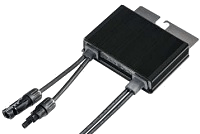
The power optimizer in the picture shows a voltage converter that connects to each solar module in your solar panel array. In short, it turns them into smart modules. By constantly tracking the MPPT or Maximum Power Point Tracking of each individual solar module, power optimizers increase system energy production.
By attaching these power optimizers to each solar module, installers can easily monitor system performance reliably. In other words, installers will be able to track, pinpoint, and resolve issues at any point along a string with surgical precision. This lowers maintenance costs dramatically over the life of your system.
Smart meters replacements provide net metering
Using a smart meter for solar net metering, sell the excess electricity that your solar panels produce right back to your utility company. That means, you make a profit when your 48V solar system becomes a source for your local electrical grid. Get credit for that excess power your solar systems produces.
As a replacement to your standard meter, a smart meter provides you with something called net metering. For an explanation, net metering analyzes and displays your local power grid’s electrical exports and imports to and from your 48V solar system.
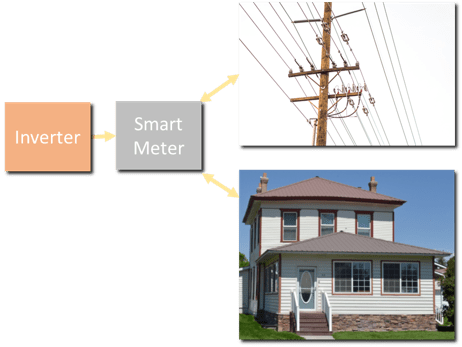
There’s another way to understand net metering. Think of your local electrical grid as a battery. During the day, most 48V solar systems produce excess electricity. Net metering uses your electrical grid to store that surplus as a credit. After the sundown, your household uses that credited power – free electricity.
Smart meters also manage additional factors. To elaborate, they manage both the energy produced by your 48V solar system and power consumed by your household. When exporting electricity to your local grid, your meter spins backwards. As a result, your electric bill receives applied credits each month.
Battery bank choices to store backup solar power
Your battery bank provides complete electrical independence – it makes off-grid solar systems possible. To explain, it provides power at night when your solar panel array isn’t producing. Also, it provides extra power in those moments when power consumption spikes above what your solar panel array provides.
As you know, not having a grid connection means you need a reliable way to store the energy generated during the day for later use. Therefore, it’s critical to have a battery bank to store enough energy to get you through each night. Also, they must support off-peak production periods like cloudy days.
48V solar system BACKUP GENERATOR
A fully self-sufficient solar systems with an ample battery bank provides backup power at night and during power outages. But unless your battery banks are huge, they may not pack enough punch for power-hungry air conditioner, pumps, or store enough energy to run your entire household for long periods of time – days or weeks of stormy weather for example.
Comparing generators to batteries is a case of apples and oranges. Each of these are considerable investments, but if energy independence and uninterrupted power is your goal, both are recommended. Now that we’ve covered battery banks, let’s focus on having a 48V solar system backup generator.
Portable vs. standby 48V solar system generator
Portable generators and home standby generators do the same basic tasks. But the two types are quite different when it comes to cost and performance. Both can handle the essentials, so your decision comes down to power, price and convenience.
These portable models tend to be noisier and to produce less power than standby models. Also, unless permanently connected, they must be wheeled out of storage, connected to your circuit breaker, and manually started.
Home standby generators and whole-house generators are professionally and permanently installed outside your home. As such, they have an insulated weatherproof housing that keeps them relatively silent. Also, they turn on automatically when the power goes out and power your entire household.
Some home backup generators run on your existing natural gas or LP fuel supply. That means, save the gas cans for your outdoor gas powered equipment.
Solar system backup generator power ratings
Generators are sold by power output measured in Watts. The amount of power they deliver determines how many appliances and other electronics they’ll handle at once. For a typical household, plan on at least 5,000 Watts of output power.
The delivery and quality of power from a 48V solar system backup generator determines how well it’ll run. For example, a generator with a high output that struggles with power delivery or quality might stall or trip a circuit breaker when it’s bogged down. Therefore, read specs and reviews before making a purchase.
Solar system backup generator transfer switch
A solar system backup generator transfer switch safely connects your standby or portable generator to your circuit panel via one cable. Without it, you’ll need to use extension cords, which can be dangerous and messy. In other words, a transfer switch is much more convenient and safe.
Determine your 48V solar system size
To determine your daily energy consumption, use the following formula:
(Watts × Daily hours used) ÷ 1000 = Daily kWh of consumption.
To calculate your annual energy consumption, use the following formula:
Daily kWh of consumption × Number of days used per year = Annual energy consumption.
This is a statement about annual electricity consumption in the U.S. by the U.S. Energy Information Administration:
“In 2020, the average annual electricity consumption for a U.S. residential utility customer was 10,715 kilowatthours (kWh), an average of about 893 kWh per month. Louisiana had the highest annual electricity consumption at 14,407 kWh per residential customer, and Hawaii had the lowest at 6,446 kWh per residential customer.”
Estimate your home appliance power usage
In the following article from Energy.Gov about estimating appliance and home electronic power usage, estimate the total electricity used by your appliances with the following four methods:
- Review each Energy Guide label to estimate the individual unit’s average energy consumption.
- Use an Electric Consumption Meter to uncover how much electricity each appliance consumes.
- Install a whole-house energy monitoring system to monitor your actual energy usage.
- Calculate your total annual energy consumption using the formulas shown below.
Installation of your 48V solar system
To begin, the Bureau of Labor and Statistics states that “Solar installers assemble, set up and maintain rooftop or other systems that convert sunlight into energy.” Though just a simple definition, it defines exactly what they do for you.
Now, please don’t attempt your own 48V solar system installation unless you’re properly trained, experienced, and certified to do so. In other words, this type of installation is not a DIY project. To explain, solar component installation and wiring requires an electrician and a construction contractor.
For a comparison, installing a complete solar system is like installing a circuit breaker unit along with other major electrical systems. One primary component of a solar system is the solar power inverter, which powers your entire home. That means, safety and reliability is no different between the two.
Construction skills are also necessary to install a solar system. To elaborate, solar panel arrays are typically secured on top of existing structures. As such, the physical connections must be strong and reliable. Sometimes, a structure is built from the ground up to carry the load of your solar panel arrays sufficiently.
Now, learn how to find the best solar system installer near you: SOLAR INSTALLERS NEAR ME: How to pick a great solar installer
For some great information on how to maintain your solar panels, be sure to read Maintaining solar panels and solar systems REVEALED.