
If you’re interested in buying a solar system for your home or business, you’ve come to the right place. It can be confusing when you hear about the different types of solar systems and the various options. That’s where this guide will help. Let’s sort out the details and uncover exactly what you need.
There are only two things to consider when buying a solar system for your home. But, each consideration does require some guidance. The first is what type of solar system you need. Next, calculate the adequate size for your household. Then, make an informed decision to achieve the best results.
Continue reading to discover what type of solar system best suites your goals and how to calculate the system size you require. Then, learn about solar system maintenance and installation. Prepare yourself to move forward with confidence.
Two major types of solar systems
Determining which type of solar system you need is easy. Is your home connected to the power grid? If so, you need a hybrid solar system. Otherwise, your household requires an off-grid solar system. Now, let’s look at the difference between the two major types.
There’s a plethora of benefits to hybrid solar that will surprise you. And now that history has proven that… READ MORE

Discover how to achieve true power independence with your own off-grid solar system, right here. Since… READ MORE
Buying a hybrid solar system for your home
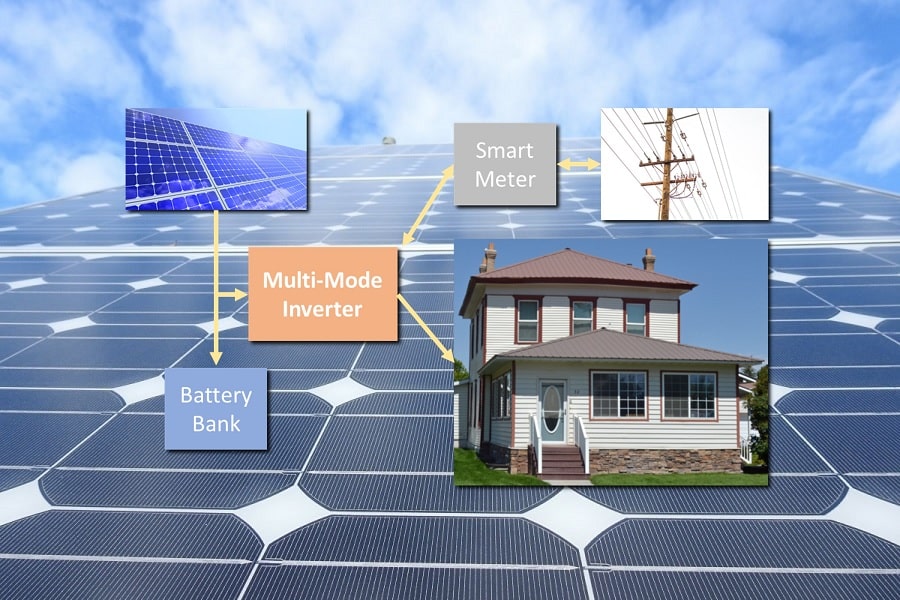
When referring hybrid solar assets, you’re talking about a self-sustaining household electrical system that is also connected to your local electrical grid. That means, this system provides three sources of electricity: solar power, battery bank power, and power from your local electrical grid.
Keeping your connection to your power grid allows you to receive unlimited electricity. That means, if you use big equipment or appliances, your electrical system will support it without fault. And if the summer heat steeply rises, use air conditioning to your heart’s content and stay cool throughout the day.
In the following video, Eric Martineau reveals more about how solar energy works. He’s the founder and owner of Just Get Solar. As you’ll see, Erick really knows his stuff!
Buying an off-grid solar system for your home
Over 300,000 homes use them for solar energy independence around the world. They know that when connected to the grid, they’re dependent on an external supplier, the utility company, for all their power. And when that power grid goes down, so does their power supply.
There’s a balance between your off-grid solar system size and your electrical needs. In order to provide true unbroken solar energy independence, your battery bank must be quite large. It must get you through long periods of little to no sunlight. Also, a backup generator may be needed depending on your region.
Small lifestyle changes ensure continuous power
Your knowledge of what uses more power in your household becomes very intimate. For example, water pumps eat power fast. That means, showers, toilet flushing, and washing dishes drain power quickly. The steps to take are small, but mindful. When you understand these factors, small changes make all the difference in conserving power properly.
Running out of power leaves you in quite a bind. You’ll either have to wait for the sun to come out again or generate power using a backup generator, if you have one. The first option is very inconvenient, while the second is very costly. Therefore, you’ll make those small lifestyle changes quickly and they’ll become your new norm throughout your life.
Calculate household energy demand
Although your household energy demand varies throughout the year, start by calculating the basics in kWh. To begin, water usage, appliance usage, and general electricity usage is where to start. Keep in mind, only calculate water-usage if you use an electric water pump to provide water to your household.
If your household uses a water pump, check your water pump’s wattage – it will vary from 250W to 1,100W. Then, take the wattage of your water pump and multiply it by the number of daily hours it runs. Finally, divide that by 1000 for the number of kWh your pump uses.
Calculate each appliance individually. As such, use the wattage value for each of your own electrical appliances and products. This will provide the most accurate estimate. Then, add them all together to calculate your total annual energy consumption.
Estimate the number of daily hours each electric appliance and product runs at the most. For example, estimate the number of hours you use each electronic device. Examples include TVs, computers, gaming systems, home audio, and so on. Then, calculate each based on the wattage stated on each label.
Performing the household energy calculation
To determine your daily energy consumption, use the following formula:
(Watts × Daily hours used) ÷ 1000 = Daily kWh of consumption.
To calculate your annual energy consumption, use the following formula:
Daily kWh of consumption × Number of days used per year = Annual energy consumption.
This is a statement about annual electricity consumption in the U.S. by the U.S. Energy Information Administration:
“In 2020, the average annual electricity consumption for a U.S. residential utility customer was 10,715 kilowatthours (kWh), an average of about 893 kWh per month. Louisiana had the highest annual electricity consumption at 14,407 kWh per residential customer, and Hawaii had the lowest at 6,446 kWh per residential customer.”
Estimating home appliance power usage
In the following article from Energy.Gov about estimating appliance and home electronic power usage, estimate the total electricity used by your appliances with the following four methods:
- Review each Energy Guide label to estimate the individual unit’s average energy consumption.
- Use an Electric Consumption Meter to uncover how much electricity each appliance consumes.
- Install a whole-house energy monitoring system to monitor your actual energy usage.
- Calculate your total annual energy consumption using the formulas shown below.
Site assessment to determine viability
Start by determining if your roof or property is big enough and has the right conditions for a solar system. In North America, a south-facing roof captures the most sunshine, producing the highest energy. Solar panels will work at most orientations and angle, but they may not perform at their max potential.
Knowing how much space is available will tell you the number of solar panels that will fit on your roof. Of course, solar panel dimensions will vary by manufacturer and model. Then, other factors affecting the available space are skylights, vents and stacks.
Equipment selection: Solar components
Choosing the right solar power equipment is important because the components typically last 25 years or longer. While you may find many variations and custom options that go into a solar system, there’s an assortment of essentials to identify and explain in simple terms.
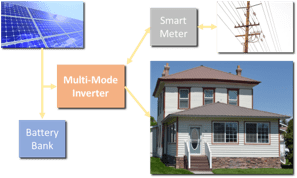
A sufficient solar system is a self-sustaining household solar system that also connects to the power grid. That means, it provides power from three sources: solar energy, battery bank backup, and your electrical utility grid.
Solar panel arrays provide free electricity
Solar panel arrays are frameworks of panels filled with photo-voltaic cells. They generate DC electricity from the energy projected by sunlight called photons. This process was first discovered by Alexandre-Edmond Becquerel back in 1839.
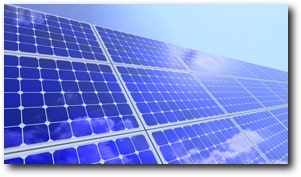
Solar panel arrays require direct sunlight to produce maximum power output. Even on cloudy days, solar panels absorb solar energy and produce power. But of course, power output reduces significantly by 25% to 40% compared to sunny days.
Panel efficiency deals with the electrical output of each panel: 320W, 290W, 270W etc. This translates into the number of panels you’ll need. To calculate, power rating divides by total panel area. That means, having a larger panel doesn’t always equate to higher efficiency.
Power optimizers maximize energy performance
Use power optimizers to maximize the energy harvest from solar power systems. First, they achieve this by individually tuning the performance of each panel within the solar panel array. Then, power optimizers are especially useful when the component performance in a distributed system varies due to shading or facing different directions.
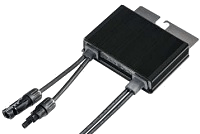
Shown here is a voltage converter that connects to each solar module in your solar panel array. In short, it turns them into smart modules. By constantly tracking the MPPT or Maximum Power Point Tracking of each individual solar module, power optimizers increase system energy production.
When you attach these power optimizers to each solar module, installers can easily monitor system performance reliably. In other words, installers will be able to track, pinpoint, and resolve issues at any point along a string with surgical precision. This lowers maintenance costs dramatically over the life of your system.
Multi-mode inverter handles all household power
A sufficient solar system is a self-sustaining household solar system that also connects to the power grid. That means, it provides power from three sources: solar energy, battery bank backup, and your electrical utility grid. As such, it takes a powerful multi-mode inverter to handle all three power sources well.
On the DC end of your multi-mode inverter, it connects to your solar panel array and battery bank. Then, it connects to your house and power grid on the 120V AC end. To be specific, it connects to the power grid through your “smart meter.”
Although your multi-mode inverter connects to your power grid, it functions as an off-grid solar inverter when your local power grid goes down. That means, it uses your solar panel array and your battery bank together to provide continuous household power while there’s a power blackout in your area.
In order to provide that continuous household power, your multi-mode inverter must support very large loads. Examples include air-conditioners, water pumps and heaters. That means, multi-mode inverters don’t require separation of essential loads and non-essential loads.
Battery bank choices to store backup solar power
Your battery bank provides complete electrical independence – it makes off-grid solar systems possible. To explain, it provides power at night when your solar panel array isn’t producing. Also, it provides extra power in those moments when power consumption spikes above what your solar panel array provides.
As you know, not having a grid connection means you need a reliable way to store the energy generated during the day for later use. Therefore, it’s critical to have a battery bank to store enough energy to get you through each night. Also, they must support off-peak production periods like cloudy days.
Traditionally, lead-acid deep cycle battery systems were the most common and reliable option for off-grid solar systems. Though a proven technology lasting over a decade, they must be kept at room temperature and not be discharged often. To explain, high temperatures, low temperatures, and fully draining lead-acid batteries internally damages and degrades them.
Lithium-ion batteries provide many advantages over lead-acid
Your best battery option for your off-grid solar system is the lithium-ion battery bank, an advanced storage device optimized for long lifespan, fast recharge, and high efficiency. Most notably, they’ve become extremely popular for their high efficiency ranging from 92% to 98%.
Lithium-ion battery banks are compact, lightweight and scalable. On top of that, they provide flexible sizing for additional capacity down the road. In other words, lithium-ion batteries may be added in the future as you’re power needs increase or if you just increase power storage for more peace of mind.
One giant advantage of lithium-ion battery banks are their ability to sustain a low or partial charge levels for prolonged periods without negative effects. Compare this to sulfation that is a common problem with lead-acid batteries. Also, lithium-ion batteries provide high charge rates – charge times are up to 70% faster than lead-acid.
Solar installation & maintenance
First, never install your own solar system unless properly trained, experienced, and correctly certified to do so. In other words, this type of installation is not a DIY project. To explain, solar component installation and wiring requires an electrician and a construction contractor to do it right.
For a comparison, installing a complete solar system is like installing a circuit breaker unit along with other major electrical systems. One primary component of a solar system is the solar power inverter, which powers your entire home. That means, safety and reliability is no different between the two.
Construction skills are also necessary to install a solar system. To elaborate, solar panel arrays are typically secured on top of existing structures. As such, the physical connections must be strong and reliable. Sometimes, structures are built from the ground up to carry the load of your solar panel arrays sufficiently.
Properly maintaining your solar panels throughout the year
Maintaining your solar panels provides solar panel improvements by keeping their performance at the highest level all the time. They require occasional light cleaning to remove dust, leaves, and debris that may be obstructing sunlight absorption. As such, general solar panel maintenance is quite simple.
Your solar panels may need more extensive maintenance during and after heavy snowfall or dust storms. Snow and dust hinders solar panels performance by obstructing sunlight. Logically, if sunlight is obstructed, the energy your solar panels generate is reduced or even may be brought to a halt.
Nowadays, free solar energy has become highly appealing for multiple reasons. First and foremost, it… READ MORE
If you’re concerned about maintaining solar panels and solar systems, you’ve come to the right place… READ MORE